Posts

Kaupapa Maori Research

Image
Been having a hard time trying to get my head around Kaupapa Maori Research and how it "fits" into my research question and literature review.  This has been my spin on how to engage with it as Pakeha in a meaningful way and not merely as some adjunct to the literature review.  This is my interpretation and just bear in mind that I am relating this to the research question of: "How can teachers navigate the murky waters of digital collaboration and collusion in high stakes student academic writing?" Researching within the Kaupapa Maori paradigm presents a challenging paradox as Pakeha.  Jones (2012, p.101) notes that a Kaupapa Maori research approach, “provides a set of rules … strategically formed by Maori, for Maori purposes … and Pakeha are necessarily outside its development”. While one understands the context for such an observation, the question arises, as to how Pakeha engage with Kaupapa Maori research from the outside?  The potential solution lies...

Research Question & Literature Review

Image
I have to say it has been quite a process trying to formulate a research question from which to base my literature review. I have invested a lot of time and energy this year into my Scholarship Physical Education students and their portfolios.  It is an interesting setup.  Students have a year to produce a piece of academic writing on something within the field of Physical Education.  I actively encourage them to choose an issue of socio-cultural and biophysical significance and, most importantly, on an issue that they have a personal connection with.  For some this is around body image and obsession, for others it may be dropping out of sport, gender identity in sport etc.   Central to this thinking was  Azzarito & Ennis (2003) who note in the field of Physical Education that, “pedagogical approaches that allow students to connect to each other, their teachers, and the real world, and also to make connections between their prior knowledge ...

Activity 3: Contribution of Teacher Inquiry Topics to my Communities of Practice

Image
Ehara taku toa i te toa takitahi engari he toa takimano My strength is not that of an individual but that of the collective Communities of Practice (CoP) are a means though which all those involved can develop their knowledge competence through social interactions with like-minded individuals.  In this sense, learning is an organic and social phenomenon.  Those involved need to be invested in the issue/topic being inquired into and demonstrate engagement, alignment and imagination (Wenger, 2000), as well as being cognisant of - but willing to suspend the impact of - time constraints, and socio-cultural environment (ego and individual agendas) ( Kerno, 2008 ).  See my previous blog post for more detail . I have two collaborative learning related teacher inquiry topics. Inquiry 1: When working with students on high stakes research based assessments over a long period of time, how do we avoid crossing the line from collaboration and into collusion? ...

"Once Bitten Twice Shy" - Communities of Practice

Image
Back in the days before MindLab, the heightened awareness of social and professional interaction and collaboration using the internet - and the plethora of tools for doing so - there was little on offer.  Conferences, professional development courses and general face-to-face communication were the primary tools for professional communication regarding practice.  One engaged with other professionals at these courses, collected as many resources as possible, and returned to school to “spread the knowledge”.  The learning tended to be confined to place and time in which they took place.  Now, with increasing use of social media and other collaborative communication platforms, learning can continue, and be shared, over longer time spans. Throughout the mid to late 90's and early 2000's, I formed local online groups to support teachers in 6th Form Certificate Physical Education, Bursary Physical Education, and the newly emerging NCEA.  A group of us decided to u...

Activity 2: A Change in My Practice Towards Future-oriented Learning and Teaching

Image
In our school, we recognise the importance of equity, diversity and inclusivity .  With respect to 21 st Century and E-Learning, we look to provide equity of access to the technology and the learning that can accrue from that.  We have worked through the process of providing equity devices, free software and, have invested in infrastructure that allows access to an increasingly diverse world.  This has come about as we have recognised that, “educational engagement and success for all learners is an important priority for 21 st Century schools” (Ministry of Education, 2012, p.25).  It is an egalitarian approach through involvement in initiatives such as He Kakano , Kia Eke Panuku and professional learning around Culturally Responsive Practice – to bring notions of excellence, equity, belonging, fairness, and the place of diversity to the forefront of our practice. HOLD ON … Can we address the elephant in our room here? How does banding or streaming ...

Future-oriented Learning and the 85 Page Behemoth

Image
The reading this week is an 85-page behemoth entitled “ Supportingfuture-oriented learning & teaching – a New Zealand perspective ” .  Being the helpful geek that I am, I thought I might summarise the subheadings within it in a few words just to make it a little easier to select one of them for Activity 2. The document works on the following premises: “21 st Century Learning” and “Future Learning” are interchangeable and is characterized as being an emerging (important word) “cluster of new ideas, beliefs, knowledge, theories and practices” (p.1).   They exist along a continuum from being highly visible in schools to barely visible. Knowledge is easily accessible so we need to rethink what we are doing with that knowledge in classrooms.  We need to move from mere transmission and acquiring knowledge, to the use of that knowledge in terms of knowing what to do with it, manipulating it and applying it in new contexts.  They use the term “fluidity” (p.2)...

Activity 1: My Reflective Practice

Image
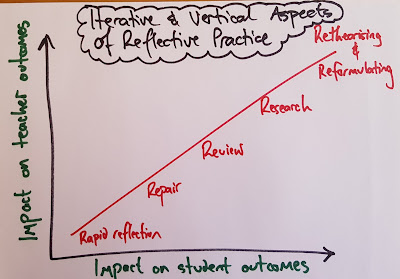
Reflective practice is seen as an essential component of professional competence ( Larrivee, 2000 ; Finlay, 2008 ; Mann, Gordon & McLeod, 2009 ) and implicitly underpins the professional standards and code of ethics in New Zealand Education (New Zealand Education Council, 2017).  Self-reflection is a product of increasing consciousness of self which has evolved over time as a product of higher mental functioning ( Gillespie, 2007 ).  This implies we are predisposed to self-reflection and instinctively take part in it.  “ The path of least resistance and least trouble is a mental rut already made. It requires troublesome work to undertake the alteration of old beliefs. ” John Dewey Dewey seem to encapsulate both the value and tension that exists within reflective practice.  We know it is of value, yet to reflect deeply/critically requires time, effort and energy – often in short supply – reducing it to a simplistic/mechanistic process to “get it out...